Four Green Pillars for Academic Libraries: NUS Libraries’ Sustainability Journey (Part 1: Green Programming and Green Resources)
17 December 2025
This post is Part 1 of a two-part blog series. This first part explores the first two pillars of green programming and green resources.
It was generously contributed by a team of librarians namely; Dr. Magdeline NG, Vice University Librarian, National University of Singapore Libraries, Ms. Gladys TOH, Assistant Librarian, National University of Singapore Libraries, Mr. Patrick PU, Principal Librarian, Research Librarian – STEM, National University of Singapore Libraries, Ms. JAMILA Osman, Principal Librarian, Research Librarian – HASS, National University of Singapore Libraries, Mr. Andy QUEK, Principal Librarian, Head of Operations, National University of Singapore Libraries, Ms. Siu Chen LIM, Senior Librarian, Research Librarian – HASS, National University of Singapore Libraries and Ms. Suei Nee WONG, Senior Librarian, Research Librarian – STEM, National University of Singapore Libraries.
Introduction
Sustainability has gained much prominence in the global zeitgeist, with the increased occurrence of extreme weather events, coupled with the boom in green technologies and the ongoing transition to renewable energy. It is no surprise, then, that sustainability has emerged as a key priority for libraries and librarians worldwide, as we embrace new roles – championing environmental responsibility, preserving cultural heritage, and leveraging digital innovation to demonstrate long-term value. At the National University of Singapore (NUS) Libraries, we’re excited to share how we’ve been building sustainability into every aspect of our library work, from our collections, to our buildings and beyond.
Our Vision for Sustainable Libraries
In a world facing unprecedented environmental and societal challenges, there is a need for academic institutions to champion information access, as well as responsible stewardship of knowledge and action for sustainability. To that end NUS Libraries believes that academic libraries play a key role in accelerating sustainability in teaching, learning, and research.
As custodians of knowledge resources and knowledge networks, we can connect our communities with a curated blend of information, knowledge networks, and platforms. Our unique position also allows us to connect our communities with relevant and current information, as well as access to history and culture through our unique collections, so they can thrive in their research while growing their sense of connectedness to the global community.
Additionally, we see ourselves as empowering learning communities through providing sustainable educational resources, innovations, and partnerships, advancing education and research while preserving heritage and reducing environmental impact for a resilient future. It is with all this in mind that we embarked on our sustainability journey.
Alignment with Industrial, National and Global Standards
NUS Libraries’ sustainability efforts are built upon, and closely aligned with, global, national and institutional efforts on sustainability. At a global level, we are guided by the United Nations 2030 Agenda and its 17 Sustainable Development Goals. Nationally, the Singapore Green Plan 2030 encourages sustainable living and development. At an institutional level, we align with our University’s commitment to achieving a carbon-neutral campus by 2030, which in turn aligns with Singapore’s national agenda on sustainable development. Finally, at an industry level, we are guided by publications such as the IFLA Guidelines for Green and Sustainable Libraries which presents a roadmap for libraries around the world to comprehensively support environmental, cultural and social sustainability.
Four Green Pillars of Sustainability for Academic Libraries
In developing our sustainability focus areas, we homed in on our bench strengths in facilities, resources, networks and partnerships, as well as expertise in technology platforms. These can be summed up in our four focus areas – or Green Pillars – for
Sustainability: (1) Green Programming, (2) Green Resources, (3) Green Facilities, and (4) Green Innovations.
(1) Green Programming: Social Sustainability and Community Engagement
Singapore is globally renowned as a “Garden City”, in which our urban landscape coexists with tropical flora and fauna. Similarly, NUS prides itself on being a very “green” campus, in every sense of the term – nestled amidst the lush greenery of Kent Ridge, as well as having a comprehensive sustainability framework. However, in the hustle between lectures and the rush to hand in assignments, it is easy for this aspect of the campus to be overlooked. This sparked a simple, yet profound, observation: we are rich in greenery, but poor in awareness of their significance for sustainability. As such, NUS Libraries has actively sought out partners and collaborators to help raise the visibility of greenery on (and off) campus, and draw attention to the importance of biodiversity in sustainability.
To that end, we partnered with researchers, departments and organisations to organise a range of events and activities to promote good health and wellbeing (SDG3) and Quality Education (SDG4). One such activity was a talk on “Are Plants Our Savior?” by Dr Amy Choong, a passionate botany expert and advocate for environmental stewardship. Another event, “Heartland Market”, is a student-led project guided closely by NUS Librarians, which brought together local producers, regulators and consumers to discuss sustainable agriculture and food security. For this event, we also actively partnered students to engage representatives from various ministries, such as the Ministry of Education and National Parks Board, including schoolteachers. Leveraging 360imx in the Central Library, the award-winning “Roots to Reefs 360” project was developed in collaboration between the NUS Department of Geography and the NUS Libraries’ Tech Central team. This initiative offers participants an immersive 360-degree experience exploring the diverse tropical ecosystems of Southeast Asia.
Other than environmental wellness events to bring the community together, we also pay attention to the wellbeing of our staff and students, and outreach to other community partners. For example, we collaborated with a student group from Communications and New Media department, (CNM Connects), on digital well-being, for the kids at Morning Star Community Services – a centre that strives to uplift children and families, building strong bonds and fostering resilience within the community. Thematic workshops such as “Fuel Your Mind: The Science of Gut Health and a Journey from Research to Industry” focused on managing individual gut health to improve mental wellbeing. This was held at the Collaborative Experiential Space, a space created in collaboration with NUS Graduate School to support the NUS graduate students and wider community in their academic, personal, and professional journeys. Together with the NUS Health and Wellbeing department, the first immersive yoga was launched at the 360imx space last year. This year, it was enhanced by incorporating virtual reality headsets, with a focus on self-care, tuning in to personal needs, and recognising when to recharge.
Collectively, these events and activities have inspired audiences to deepen their knowledge and take meaningful action in enabling conservation and community-led conservation efforts.
(2) Green Resources: Cultural Sustainability through Heritage Preservation
As an academic library, we are stewards of the institutional and cultural memory entrusted to us, and provide access to that history and culture (SDG 11). Access to information and knowledge supports inclusive education (SDG 4). We also believe that we are unable to do this alone but must work collaboratively with partners. We weave sustainability principles into our collections by practicing acquisition and preservation with the aim of preserving diverse cultures. We do this through 5 main areas:
1. Development of Special Collections
2. Digital Preservation
3. Augment University Curriculum
4. Advance Research Projects and Enquiries
5. NUS Archives
6. NUS Heritage Projects
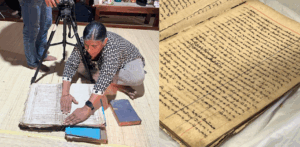
A recent example would be the seminar titled, “Shared Waters: The Maritime Heritage of Singapore and Sulawesi” to showcase the collection, discuss its cultural significance, and promote academic research on the Bugis and Makassar communities. The pride of this collection is the Daeng Paduppa manuscript, a two-century old document which sheds light on the historical and trade interactions between the seafaring Bugis-Makassar and pre-modern Singapore.
The Biodiversity Library of Southeast Asia is another key example of partnership for heritage and preservation for cultural sustainability. Jointly maintained by NUS Libraries and the Lee Kong Chian Natural History Museum is rooted in the collections of the former Raffles Library and Museum (1874–1960). Rare publications from the library are preserved and digitised by NUS Libraries for open access to further learning and research. To expand the collection’s reach and impact, we also host biodiversity talks and outreach events to increase public engagement with Southeast Asia’s natural history and conservation.
Our preserved collections are pivotal in resources in the Undergraduate Research Library Fellowship programme, which offers undergraduate the opportunity to utilise the library’s collection, under the mentorship of librarians, to pursue their proposed research topics. This close collaboration allows both librarians and students deepen their understanding of research processes and the library’s resources.
Explore more at our Digital Gems Platforms.
Coming up in Part 2
In the next post, we’ll delve into the remaining two Green Pillars (Green Facilities and Green Innovations) showcasing how NUS Libraries is building sustainable infrastructure and leveraging digital transformation for a greener future.
Acknowledgements
The authors would also like to thank all who contributed to the presentation in one way or another including NUS Librarians whose work was featured in this presentation, our partners from various faculties, departments and organizations, the ALA IRRT Webinar Committee (Katie Spires, Polly Boruff-Jones and Delin Guerra), ALA SustainRT. Special thanks Gina De Alwis Jayasuriya, PhD, CPD Researcher (Asia) for her hard work in helping to publicize this webinar. Thanks also to Zaki for the banner, and Ma Guangyi and Marcus Wong from NUS Libraries Marcomms for the design of the sustainability webpage. We would also like to thank Marcus Wong and our University Librarian Associate Professor Natalie Pang for reviewing the drafts of this piece.
CRediT author statement
Magdeline Ng: Supervision, Conceptualisation of the webinar and writing, Speaker in webinar, Writing-Reviewing and Editing. Gladys Toh: Speaker in webinar, Writing-Reviewing and Editing. Patrick Pu: Speaker in webinar, Writing-Reviewing and Editing. Jamila Osman: Speaker in webinar, Andy Quek: Speaker in webinar, Siu Chen Lim: Conceptualisation of the webinar and writing, Writing-Original draft preparation, Reviewing and Editing. Suei Nee Wong: Conceptualisation of the writing, Writing-Original draft preparation, Reviewing and Editing.