Doing Dynamic Digital Inclusion Locally
18 December 2025
Libraries, alongside post offices, have a unique ability to offer solutions to the complex challenge of digital inclusion. With the right support and integration into wider planning, they can make a reality of digitally driven development.
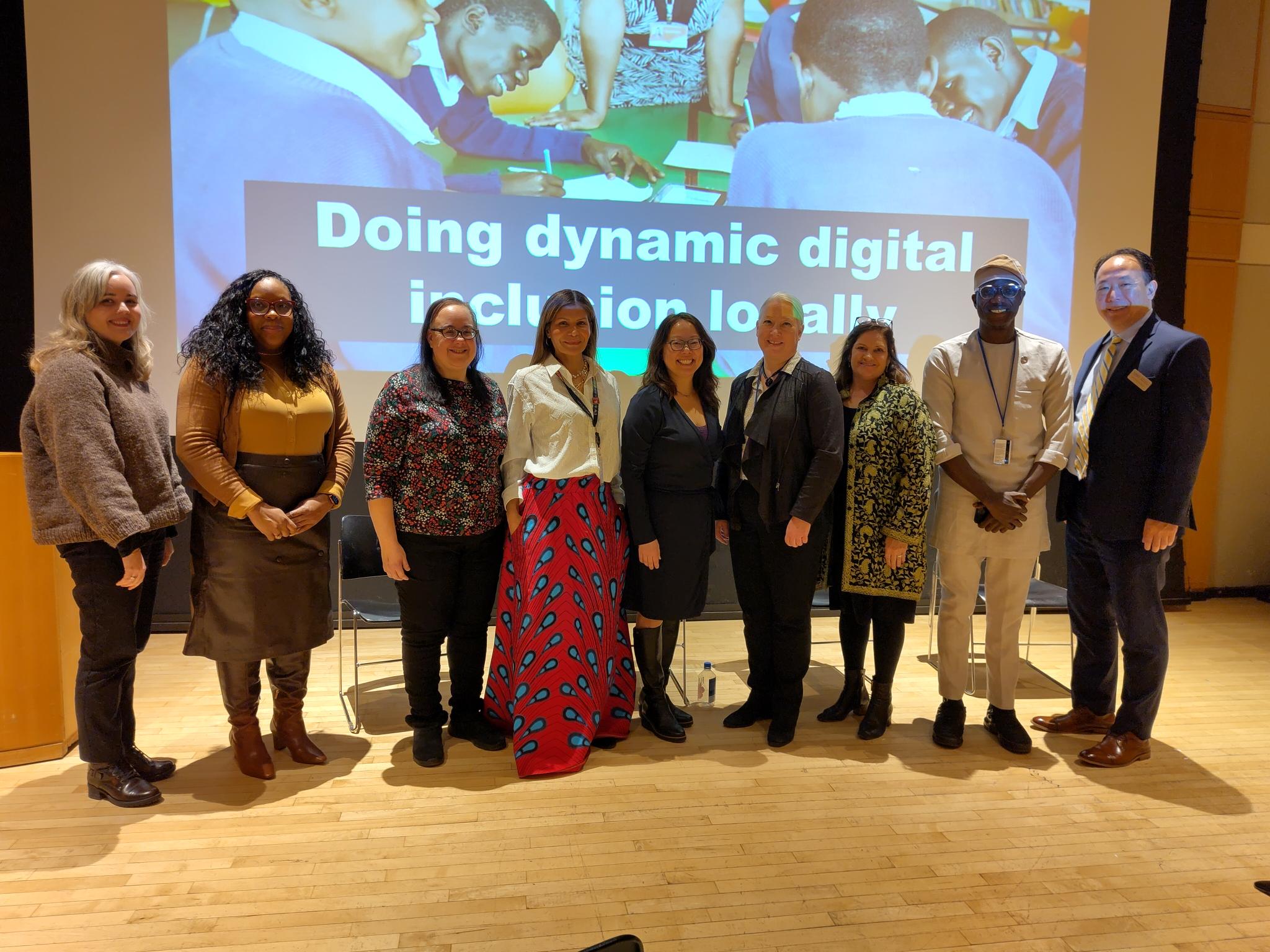
IFLA was proud to work with the UNESCO Information for All Programme and the American Library Association’s SDGs Task Force to organise a side-event around the WSIS+20 High-Level Meeting, which brought to an end the 20 year review of the World Summit on the Information Society process.
Held at the CUNY Graduate Center in New York, the session was chaired by IFLA Governing Board member Loida Garcia Febo, with the participation of:
- Guilherme Canela De Souza Godoi,Director for Digital Inclusion, Policy and Transformation and the IFAP Secretary of UNESCO
- Kevin Hernandez, Digital Inclusion Expert, Universal Postal Union
- Damilare Oyedele, CEO and Co-Founder, Library Aid Africa
- Dr Anthony Chow, Director of SJSU iSchool will highlight wider work to innovate digital inclusion practices
- Diana Price, Central Library Manager, Alexandria, VA
- Maria McCauley, ALA President-elect
In her introduction Loida Garcia Febo underlined that in an evolving digital environment, inclusion programmes needed to be dynamic, and designed in ways that responded to local needs. ALA President-elect Maria McCauley underlined how libraries’ centuries old mission to provide access to knowledge was as relevant in the digital age as ever, and indeed that they were playing a coordinating role in many communities among relevant actors.
Guilherme Canela De Souza Godoi underlined the scale of the challenge, in particular for groups at risk of marginalisation. He highlighted the importance of addressing multilingualism, as well as the potential for open solutions as a response, and urged the audience to seek inspiration from the recent UNESCO IFAP Issue Brief on Empowering Libraries for an Inclusive Digital Future.
Kevin Hernandez underlined how post offices have mobilised to become major actors in digital inclusion, drawing on recent Universal Postal Union research. Already a large share offer a variety of digital services, from eGovernment to financial inclusion and eCommerce. Post offices were transforming themselves into multi-channel hubs and one-stop-shops for their communities. Yet there was more to do, in particular in rural post offices which were still less likely to be online.
Damilare Oyedele highlighted the work of Library Aid Africa to mobilise librarians to innovate in how they realise libraries’ potential to drive digital inclusion. In particular, they had worked to build the confidence and skills necessary to engage proactively in digital inclusion and internet governance policies and strategies, in order to ensure that the potential of libraries is recognised and integrated from the start.
Dr Anthony Chow stressed that digital inclusion is about more than just an internet connection, and needed to include both access to content and skills – including around new issues like AI. There was the potential to realise economies of scale by standardising much programming, without losing the potential to adapt to local circumstances. Furthermore, libraries could also drive community-wide inclusion efforts.
Diana Price underlined that digital exclusion is a reality in many urban areas, for example due to slow connections or the need to share devices. Libraries had responded by providing hotpots and computers, and support to access and use tools critically and ethically. They had invested in particular in outreach, to ensure that those who would benefit most know about what is on offer, in order to level the playing field.
In response to the question of what governments in turn could do to maximise the potential of libraries and post offices as drivers of digital inclusion, a first key point was simply recognition – it is not enough for strategies to focus on individual connectivity alone. Secondly, and linked to this, governments need to accept that digital inclusion is essentially local, and requires responsive solutions.
Third, librarians and post office workers themselves needed both to have a seat at the table, and to have the skills and knowledge to make the most of this. This was not something traditionally taught in the context of basic education, and so additional programmes are needed.
Fourth, in addition to a broader need for investment, in particular to overcome economic inequalities between regions, there was a particular role for universal service funding, such as eRate in the United States. Such programmes had a major contribution to make.
Finally, governments, libraries and post offices alike needed to be ready to think at scale, and look at how to mobilise regional and national networks in order to accelerate contributions to digital inclusion.
Watch the recording here:
We are grateful for the support of the Gates Foundation, via SIGL, which made this side-event possible.