Four Green Pillars for Academic Libraries: NUS Libraries’ Sustainability Journey (Part 2: Green Libraries and Innovations)
02 January 2026
This post is part 2 of a two-part blog post series. It was generously contributed by a team of librarians namely; Dr. Magdeline NG, Vice University Librarian, National University of Singapore Libraries, Ms. Gladys TOH, Assistant Librarian, National University of Singapore Libraries, Mr. Patrick PU, Principal Librarian, Research Librarian – STEM, National University of Singapore Libraries, Ms. JAMILA Osman, Principal Librarian, Research Librarian – HASS, National University of Singapore Libraries, Mr. Andy QUEK, Principal Librarian, Head of Operations, National University of Singapore Libraries, Ms. Siu Chen LIM, Senior Librarian, Research Librarian – HASS, National University of Singapore Libraries, Ms. Suei Nee WONG, Senior Librarian, Research Librarian – STEM, National University of Singapore Libraries.
In the first part of our blog post series, we outlined our vision and shared how NUS Libraries is advancing social and cultural sustainability through Green Programming and Green Resources. In Part 2, we turn our focus to the physical and digital realms: exploring how our Green Facilities and Green Innovations pillars are helping us create a more sustainable learning environment, while highlighting our ongoing efforts and lessons learned.
(3) Green Libraries and Environmental Sustainability: Buildings and Practices
Situated in Singapore’s tropical climate, where high temperatures and humidity make air-conditioning a necessity for comfort, NUS Libraries faces the challenge of balancing effective cooling with sustainable practices. We have integrated innovative infrastructure solutions (SDG9) that enable significant reductions in heat and energy usage (SDG12), while still providing a comfortable learning environment.
To futher this goal, NUS Libraries took major steps to upgrade and renovate our library buildings, achieving the BCA Green Mark Platinum in both 2019 and 2022. The BCA Green Mark Scheme has become the foundation of Singapore’s first green building masterplan, setting the direction for sustainable development. The main goal was to encourage, enable, and engage the industry to adopt greener building practices.
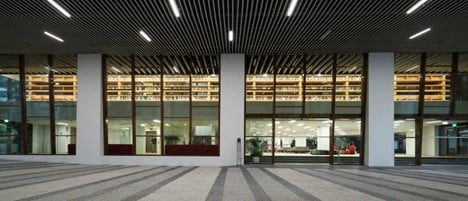
Created as one of the main art installations in the Central Library, the BookBridge is an innovative bookshelf constructed from tropical Mass Engineered Timber (MET), a renewable and sustainable material used in architecture.
Source: NUS Libraries
To align with the national push for sustainability, several initiatives were highlighted, including a 360 virtual tour featuring the MSL mural wall, which showcases the faculty heritage in learning and research areas especially on decarbonisation, urban farming and advancements in biological sciences. The Bookbridge project, developed in collaboration with Professor Shinya Okuda from the NUS Department of Architecture, uses sustainable tropical Mass Engineered Timber (MET) for the bookshelves. This initiative has become an iconic symbol of the library’s mission to bridge knowledge from the past to present. Additional efforts include the use of spatial design to conserve energy, optimising temperature control through consistent air conditioning, maximising natural light with glass features, integrating greenery, utilizing fans at atrium after office hours when the weather is cooler.
(4) Green Innovations: Digital Sustainability
As Universities and academic libraries inexorably transit to digital platforms and resources, we must be mindful that while digital solutions offer sustainable alternatives to paper-based learning material – thus reducing the need to cut down forests – they do come with their own inherent carbon footprint as well, such as heightened energy consumption from AI tools and IT server infrastructure. While we must keep pace with the latest resource formats, we must do so responsibly without compromising long term environmental, social and economic wellbeing.
How do we do this? First, we support digitalisation for sustainability, for example through the use of digital tools to achieve environmental targets (SDG 9). We do this by partnering with the University Campus Infrastructure to install solar panels on the rooftops of our libraries to harness solar energy and reduce the overall carbon footprint.
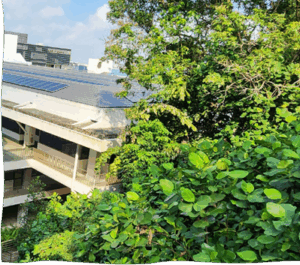
Second, the library practices sustainable digitalization through, for example, migrating servers from inefficient local servers that are costly to maintain due to heating issues and electricity consumption to the cloud. This resulted in savings not just in terms of finances but also impact on the environment.
For more information, please visit our Green Digital and Innovation webpage.
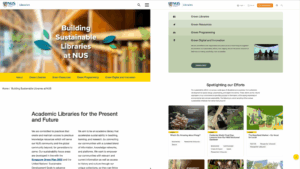
NUS Libraries’ Page on Building Sustainable Libraries
To showcase our commitment to building sustainable libraries for the community, we launched the NUS Libraries Sustainability Webpage in May 2025. This dedicated online platform serves as a key resource to sustainability activities at NUS Libraries. It highlights our core green initiatives, resources, and collaborations in support of our sustainability ambition. Explore our focus areas – green libraries, green resources, green programming, and green digital and innovation initiatives. The webpage also serves as a guide for the ways in which students, staff, and partners can get involved. By making our sustainability journey visible and accessible, we aim to inspire collective action and reinforce our role as a leader in advancing sustainable library practices within and beyond the academic community.
Conclusion
We hope the sharing above has provided you with some thoughts on how to integrate sustainability into your core mission. Aligning with broader goals, preserving heritage, building green, embracing digital innovation, and fostering community engagement – are all key to creating a library that is ready to innovate – responsibly to prepare for the challenges of tomorrow.
However, it is important to acknowledge that our efforts are not without limitations. For example, while green programming and resources are designed to further social and cultural sustainability, the activities involved may inadvertently increase the library’s overall carbon footprint. Likewise, although digital innovations can offer solutions to many sustainability challenges, they may also lead to higher energy consumption and, in some cases, even greater carbon emissions due to increased server loads and cooling demands.
Recognizing these challenges, there is potential for us to implement more robust methods of carbon accounting to better understand the environmental impact of our activities. At the same time, we must remain open and proactive in exploring alternative approaches across each sustainability pillar to ensure our strategies continue to evolve in response to emerging challenges. By critically examining our practices and remaining committed to continuous improvement, we can strive toward a more truly sustainable library for the future.
Acknowledgements
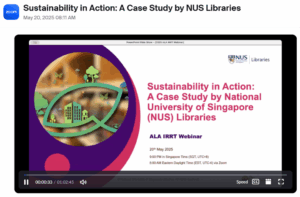
The authors would also like to thank all who contributed to the presentation in one way or another including NUS Librarians whose work was featured in this presentation, our partners from various faculties, departments and organizations, the ALA IRRT Webinar Committee (Katie Spires, Polly Boruff-Jones and Delin Guerra), ALA SustainRT. Special thanks Gina De Alwis Jayasuriya, PhD, CPD Researcher (Asia) for her hard work in helping to publicize this webinar. Thanks also to Zaki for the banner, and Ma Guangyi and Marcus Wong from NUS Libraries Marcomms for the design of the sustainability webpage. We would also like to thank Marcus Wong and our University Librarian Associate Professor Natalie Pang for reviewing the drafts of this piece.
CRediT author statement
Magdeline Ng: Supervision, Conceptualisation of the webinar and writing, Speaker in webinar, Writing-Reviewing and Editing. Gladys Toh: Speaker in webinar, Writing-Reviewing and Editing. Patrick Pu: Speaker in webinar, Writing-Reviewing and Editing. Jamila Osman: Speaker in webinar, Andy Quek: Speaker in webinar, Siu Chen Lim: Conceptualisation of the webinar and writing, Writing-Original draft preparation, Reviewing and Editing. Suei Nee Wong: Conceptualisation of the writing, Writing-Original draft preparation, Reviewing and Editing.