Seeds of Literacy: How National Library of Indonesia’s KELANA Nurtures Children’s Learning and Supports SDG 4
20 December 2025
At the heart of the National Library of Indonesia’s mission lies a deep commitment to building a literate, creative, and informed generation. To bring this vision to life, the National Library of Indonesia launched KELANA (short for Kelas Literasi Anak or Children Literacy Class), an inclusive literacy class designed to introduce children to the power of reading, creativity, and knowledge. The programme was held from March to September 2025 with six different themes in each session.
KELANA reflects the spirit of Sustainable Development Goal 4: Quality Education (SDG 4), particularly in ensuring inclusive and equitable education for all. Through its sessions, the programme provides children with meaningful learning experiences that connect stories with values, while basic literacy skills—reading, writing and numeracy —are developed. Each KELANA class is thoughtfully crafted by librarians who act not only as facilitators but also as educators and promoters of lifelong learning. The programme took place in the Children’s Services area in the National Library, transforming it into a space full of laughter and the best stage for children to perform confidently at an early age. Children sat together with their peers and parents, listening to stories, engaging in creative activities, and learning new concepts in ways that were both fun and purposeful.
The themes of KELANA evolve with each edition, responding to social and educational needs. In its early editions, children explored environmental literacy, learning how to care for the planet through stories about recycling and pollution. In another edition, KELANA turned its focus to financial literacy, helping children understand the value of money, saving, and mindful spending. Through interactive games, storytelling and read-aloud sessions, participants discovered that literacy also means being wise in managing resources. The fifth KELANA, themed around drama through picture books, saw participants act out stories according to the storylines of books. The sessions encouraged creativity and expression through “Bookish Play”— play activities inspired by or directly involving books. These activities aim to help children visualise and understand the books’ contents, and develop their creativity through various activities such as drawing, crafts, or experiments related to the story plots. Children also took part in writing workshops, where they learnt to transform ideas into stories and stories into meaningful messages. This also reflected the Library’s belief that every small step in learning can grow into meaningful change.
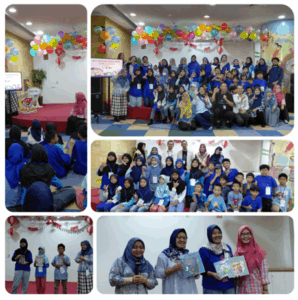
During the celebration of Indonesia’s National Children’s Day, KELANA invited families to join Literacy Adventure: Playing and Learning with Familythe – a session that was designed to create a space for children and their families to learn together and utilise the facilities at the National Library. KELANA activities can strengthen the bond and attachment between parents and children through fun playdates. Parents can also gain new knowledge in improving literacy in the family environment. Later in the year, KELANA addressed the theme of digital safety, teaching children how to navigate the online world responsibly. With the support of experts from ICT Watch, an Indonesian civil society organisation focused on digital literacy and internet governance, young participants learnt about online ethics, privacy, and the importance of kindness in digital spaces.
What makes KELANA remarkable is its holistic approach to literacy. Going beyond reading comprehension, it nurtures creativity, empathy, and awareness of social issues. The sessions are free and open to the public, ensuring that every child, regardless of background, can participate and learn. In doing so, the programme strengthens one of the key pillars of SDG 4, namely inclusive access to quality education.
Parents and educators have noted how the programme builds children’s curiosity and confidence. For librarians, KELANA has also been a platform forprofessional growth, allowing them to learn more about children’s interests and character development. The synergy between librarians, guest facilitators, and families makes each KELANA class more attractive.
As an institution, the National Library of Indonesia sees KELANA not only as an event series but as a growing model for sustainable literacy development. By combining the strengths of libraries, technology, and community collaboration, KELANA aspires to make the pursuit of literacy a shared journey and an enjoyable activity in libraries for children. In nurturing children’s imagination and understanding of the world, KELANA plants the seeds of literacy that will one day blossom into lifelong learning. It is a testament to how libraries, through creative and inclusive initiatives, can bring the goals of SDG 4 to life.
Contributed by Restu Putri Sholikhah and Julia Nashri, Librarians, National Library of Indonesia